Salary increase percentage: your raise and whether it beats inflation
Reading time: 6 min · 8 sections
Your salary increase percentage is the raise divided by what you were paid before: 52,000 going to 55,120 is a gain of 3,120 on a base of 52,000, which is 6%. Everything else about a raise, from hourly rates to inflation, is a variation on that one division.
I have turned pay figures into percentages for a long time, and the same slip turns up again and again: people divide by the new number, or they subtract inflation and call it done. Both give an answer that looks right and is not. The percentage increase calculator does the arithmetic below for you, with every step shown, but the method is short enough to carry in your head.
The formula, in three steps
- Subtract: 55,120 − 52,000 = 3,120. That is the raise in money.
- Divide by the old pay: 3,120 ÷ 52,000 = 0.06.
- Multiply by 100: 0.06 × 100 = 6%.
Write the base down before you write the percentage. The old pay is the base because the question is "how much more than I had?". Divide 3,120 by 55,120 and you get 5.66%, a number that answers a different question and understates every raise you will ever check. A quick test: apply your answer back to the old pay. 52,000 × 1.06 = 55,120, so 6% is right.
Annual, monthly or hourly: the percentage is the same
As long as both figures use the same period and the same hours, the period cancels out. Take the same raise three ways:
| Basis | Old | New | Raise | Percent |
|---|---|---|---|---|
| Per year | 52,000 | 55,120 | +3,120 | +6% |
| Per month | 4,333.33 | 4,593.33 | +260.00 | +6% |
| Hourly, 18.50 to 19.75 | 18.50 | 19.75 | +1.25 | +6.7568% |
| Hourly, as a 2,080-hour year | 38,480 | 41,080 | +2,600 | +6.7568% |
The yearly and monthly lines are the same 6% raise, because dividing by twelve changes both numbers equally. The hourly rows are a different raise: 1.25 more per hour on 18.50 is 6.7568%. If your hours change as well, a percentage on the hourly rate and a percentage on your total pay stop agreeing. Compare like with like: rate with rate, total with total, gross with gross.
A flat raise is a different percentage for everyone
A flat amount sounds fair until you do the division. A 2,000 raise on 40,000 is 5%; the same 2,000 on 80,000 is 2.5%. When a company announces a flat raise or a one-off figure, convert it to a percentage of your own pay before you compare it with anyone else's number or with a percentage figure for the cost of living.
Going the other way: from a target to a new salary
Sometimes you start from the percentage. To raise 52,000 by 3.5%, multiply by 1.035: 52,000 × 1.035 = 53,820. The multiplier is one plus the rate written as a decimal, and it gets the old pay and the raise in one step.
The reverse is where mistakes cluster. If you know the new pay and the percentage and want the old pay, divide by the multiplier. 55,120 ÷ 1.06 = 52,000. Do not take 6% off 55,120: that gives 51,812.80, because the 6% was calculated on the old pay, which you do not have yet. The calculator does this reverse step for you when you enter the new pay and the percent and leave the original empty, and the price increase guide uses the same idea for prices.
Did the raise beat inflation?
This is the question behind most raise checks, and the quick answer people give is "6% minus 2.9% is 3.1%". It is close, but it is only an approximation. The exact figure divides instead of subtracting:
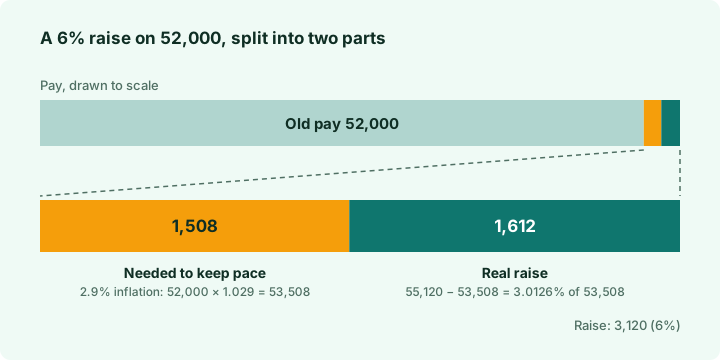
With a 6% raise and 2.9% inflation: 1.06 ÷ 1.029 = 1.030126, so the real raise is 3.0126%. To simply keep pace you needed 52,000 × 1.029 = 53,508. Everything above 53,508 in the 55,120 is a real gain: 1,612 of the 3,120.
The gap between subtraction and division grows as the numbers get larger, and it matters most when the margin is thin:
| Raise | Inflation | Quick subtraction | Exact real raise |
|---|---|---|---|
| 4% | 3% | 1% | 0.9709% |
| 6% | 2.9% | 3.1% | 3.0126% |
| 10% | 8% | 2% | 1.8519% |
| 20% | 15% | 5% | 4.3478% |
Use one inflation figure that covers the same stretch of time as your two pay figures, from one consistent price index, such as a consumer price index series. The calculator has an optional inflation field for this; you type the figure yourself, because nothing in it connects to the internet. A raise that lands below the inflation rate is a real pay cut even though the paycheck is bigger, and the same arithmetic shows by how much.
Several raises in a row compound
Raises of 3%, 4% and 2.5% over three reviews do not add up to 9.5%. Each one applies to the pay left by the one before:
| Review | Raise | Pay afterwards |
|---|---|---|
| First | +3% | 53,560.00 |
| Second | +4% | 55,702.40 |
| Third | +2.5% | 57,094.96 |
The total is 57,094.96 ÷ 52,000 − 1 = 9.798%, not 9.5%. To describe it as one steady yearly raise, take the third root of 1.09798, which gives 3.1648% a year; the CAGR guide explains why that, and not 9.798 ÷ 3, is the figure to quote. The calculator's successive changes mode takes the three raises as rows and gives the same 9.798% and the pay afterwards. And if you meet a pay figure quoted as "points" rather than percent, the guide to percent change, percent difference and percentage points sorts out which wording means what.
Comparing a job offer with your current pay
An offer of 52,000 against a current 48,000 is a jump of 4,000, and 4,000 ÷ 48,000 = 8.3333%. Before that number means anything, line up what is being compared: gross against gross, the same number of paid hours, and the same treatment of bonus and benefits. A percentage is only as honest as the two figures behind it. I will not tell you what figure to ask for; the arithmetic can tell you what a given counter-figure is worth as a percentage over your pay today.
A checklist before you quote your number
- Write the old pay first, then the new pay, both on the same basis.
- Divide the difference by the old pay, never the new.
- Check it backwards: old pay × (1 + rate) should return the new pay.
- Pick one inflation figure for the same period and divide, do not subtract.
- For a series of raises, multiply the multipliers.
Frequently asked
How do I calculate my salary increase percentage?
Subtract your old salary from the new one, divide the result by the old salary and multiply by 100. For 52,000 to 55,120 that is 3,120 ÷ 52,000 × 100 = 6%.
How do I find my new salary after a percentage raise?
Multiply the old salary by one plus the raise as a decimal. A 3.5% raise on 52,000 is 52,000 × 1.035 = 53,820.
How do I find my old salary from the new salary and the raise percentage?
Divide the new salary by one plus the raise as a decimal. 55,120 after a 6% raise is 55,120 ÷ 1.06 = 52,000, not 55,120 minus 6%.
Did my raise keep up with inflation?
Divide one plus your raise by one plus the inflation rate and subtract one. A 4% raise with 3% inflation gives 1.04 ÷ 1.03 − 1 = 0.97%, so it kept up, with very little to spare.
Is a flat raise the same percentage for everyone?
No. The same flat amount is a smaller percentage of a larger salary: 2,000 is 5% of 40,000 but 2.5% of 80,000.