Price increase percentage: find the old price, stack rises, recover
Reading time: 6 min · 7 sections
A streaming plan goes from 2.99 to 3.49 and the email calls it a small adjustment. As a price increase percentage it is 16.72%, which is not small at all. The size of a price rise only shows up once you divide it by the old price.
Prices are the place where people feel percentages and rarely compute them, so the sums below are the ones I check most often: what a rise really is, what the price was before it, what happens when rises and cuts are stacked, and whether a rise beat general inflation. The percentage increase calculator runs each of them, but they are short enough to do on a receipt.
Reading a price rise
| Item | Old | New | Change | Percent |
|---|---|---|---|---|
| Subscription, per month | 2.99 | 3.49 | +0.50 | +16.72% |
| Rent, per month | 1,450 | 1,595 | +145 | +10% |
| Coffee | 4.00 | 4.50 | +0.50 | +12.5% |
Notice that the same 0.50 is 16.72% on the subscription and 12.5% on the coffee. The size of the base decides it. Over a year the subscription costs 6.00 more, and the rent costs 1,740 more, so the money figure is worth knowing too. I always write both: the amount and the percentage.
Finding the price before the increase
You see a label of 64.80 and a note that it went up 8%. What was it before? The tempting move is to take 8% off 64.80, which gives 59.62. It is wrong, because the 8% was charged on the old price, not on 64.80.
- Turn the rate into a multiplier: 1 + 8 ÷ 100 = 1.08.
- Divide the new price by it: 64.80 ÷ 1.08 = 60.00.
- Check forwards: 60.00 × 1.08 = 64.80.
The same method works for the rent: 1,595 after a 10% rise was 1,595 ÷ 1.10 = 1,450. For a price cut the multiplier is below one: 44 after a 10% discount was 44 ÷ 0.90 = 48.89. That is the usual "reverse percentage", and the calculator does it directly: enter the new price and the percent, leave the original empty, and it also shows the check backwards.
Stacked increases: multiply, never add
Suppose a product rises 5%, then 3%, then falls 2% after a promotion. Adding gives +6%. The real total is smaller, because each step works on the price the previous one left:
| Step | Multiplier | Price |
|---|---|---|
| Start | 100.000 | |
| +5% | × 1.05 | 105.000 |
| +3% | × 1.03 | 108.150 |
| −2% | × 0.98 | 105.987 |
The overall change is +5.987%, not +6%. Two straight 10% rises make 21%, not 20%, and +10% followed by −10% leaves you at 99, which is −1%. The small gaps feel harmless until the numbers are big; on a bill of 100,000 the difference between 6% and 5.987% is 13. The calculator's successive changes mode takes each step as a row and shows the overall change, the final price from a starting value and the change needed to get back.
Why +20% then −20% loses money
Take 50. Raise it 20% and you have 60. Cut 20% from 60 and you are at 48, which is 4% below where you began. The second 20% is taken from a larger number, so it removes more than the first one added. The order does not matter; the loss is the same either way round.
The honest way to undo a change is to ask what percentage of the new price gets you back:
| Fall | Price from 100 | Rise needed to recover |
|---|---|---|
| −10% | 90 | +11.11% |
| −15% | 85 | +17.65% |
| −20% | 80 | +25% |
| −25% | 75 | +33.33% |
| −50% | 50 | +100% |
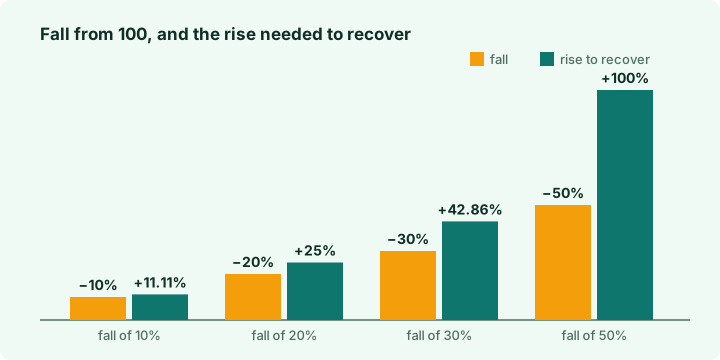
The reverse is just as useful for a rise. A price that went up 25% needs a 20% cut to return, not 25%: 1 ÷ 1.25 = 0.80. If a seller offers "20% off the new price" to cancel a 25% rise, they are giving you exactly back what they took, and nothing more.
Is the rise more than inflation?
A price up 10% sounds like a lot until you set it against what everything else did. If general prices rose 3% over the same stretch, the real increase is 1.10 ÷ 1.03 − 1 = 6.80%. The price rose 6.80% faster than the general level, not 7%.
Where do you get the general level? From a consumer price index. A classroom exercise from the U.S. Bureau of Labor Statistics shows the method: an index that moves from 141.8 to 244.955 is a rise of about 72.7% in the price level, so an item that cost 5.00 at the start corresponds to roughly 8.64 at the end. Two rules from that exercise are worth keeping: use the same index series for both values, and compare the same two moments in time as your two prices. The calculator takes the inflation figure you type and divides it out; it never fetches one for you.
Same price, smaller pack
The sneakiest price increase leaves the label alone. A pack that held 500 g at 4.00 now holds 450 g at 4.00. The price per 100 g moves from 0.80 to 0.8889, which is an increase of 11.11%. The shortcut: old quantity ÷ new quantity − 1, here 500 ÷ 450 − 1 = 11.11%. Whenever the quantity changes, compare unit prices, then run the usual percentage.
One boundary to keep clear: this guide measures a price against its own earlier price. Markup and margin measure a price against its cost, which is a separate question with its own formulas, so do not borrow these steps for that.
Habits that keep the numbers straight
- Always divide by the starting price. If your answer changes when you swap the two prices, you divided by the wrong one.
- Reverse with a division by the multiplier, not a subtraction of the percentage.
- Stack changes by multiplying. For a longer run of rises, see how CAGR turns a total into a yearly rate.
- For pay rather than prices, the same checks appear in the salary increase guide.
- When a rate itself is quoted, such as an interest rate, ask whether the change is in points or percent: the percent change and percentage points guide covers it.
Frequently asked
How do I calculate a price increase percentage?
Subtract the old price from the new price, divide by the old price and multiply by 100. From 2.99 to 3.49 is 0.50 ÷ 2.99 × 100 = 16.72%.
How do I find the price before an increase?
Divide the new price by one plus the increase as a decimal. 64.80 after an 8% increase was 64.80 ÷ 1.08 = 60.00.
Why does a 20% increase followed by a 20% decrease not return to the start?
The decrease is taken from the larger, increased amount. 50 up 20% is 60, and 60 down 20% is 48, which is 4% lower than the start.
How much of a rise is real after inflation?
Divide one plus the price rise by one plus inflation and subtract one. A 10% rise with 3% inflation is 1.10 ÷ 1.03 − 1 = 6.80% in real terms.
How do I compare prices when the pack size changes?
Work out the price per unit for both packs, then take the percentage change of those unit prices. 500 g to 450 g at the same price is an 11.11% rise.